

Anxiety & Stress Management
Help! My Child is Anxious: A Parent’s Guide to Back-to-School Anxiety
September 1, 2026
The start of a new school year can bring excitement, new routines, and sometimes a lot of worry. When your child says, “I don’t want to go to school,” your first instinct may be to fix it. But what if helping them isn’t about making the anxiety disappear? Learn how to support your child as they build confidence and move through their worries.
Just yesterday you were excited for baseball games, pool days and family vacations. Yet here you are. The backpacks, school supplies and new outfits are ready, and school is back in session. You hear your child say, “I don't want to go to school tomorrow.” The first instinct is often to put your detective hat on and start an investigation. What's wrong? Did something happen? Are you worried about your friends? Did someone say something? How can I fix it?
As parents, the instinct is to try and make anxiety go away. You want to tell them they're safe, promise them nothing bad will happen, or find a way to make school feel easier. However, this instinct can lead to greater anxiety. The goal isn't to remove all of your students' anxiety but to assist them as they move through it.
Remember those finger traps many of us grew up playing with? The more you pulled your fingers apart, the tighter the trap became. The only solution? To resist the urge to pull away. When you pushed your fingers together, the trap came loose. Sometimes, just like the trap, the harder we fight anxiety, the tighter its grip becomes. Likewise, students need to lean into their anxiety to learn they are strong enough to manage it.
What is anxiety?
Anxiety is an alarm system that exists to protect you. It starts in the amygdala (an almond sized part of our brain). A distress signal is sent out too many other parts of the brain and eventually reach the body causing that “fight, flight, freeze” feeling. The DSM5-TR (Diagnostic Statistical Manuel) suggests that there are 11 different types of anxiety diagnosis. Some of the more common ones include:
· Generalized Anxiety Disorder: Chronic, exaggerated worry about everyday things.
· Panic Disorder: Sudden, repeated attacks of intense fear or terror.
· Social Anxiety Disorder: Overwhelming worry and self-consciousness in everyday social situations.
· Separation Anxiety Disorder: Excessive fear about being apart from people you are close to.
The students who are dealing with back-to-school anxiety may be experiencing one or more of the symptoms listed above. When they feel this, often you will see a shift in behavior. This behavior may look different depending on the students age, developmental progression, etc.
Symptoms by age
While there is no exact formula for what symptoms your child may experience, your child’s symptoms will most likely manifest differently based on where they are developmentally. Here is an idea of how they may show up by age:
Ages 4-10
o Somatic Complaints: Your student may share that they have a stomachache, that they feel sick or have a headache. These symptoms would typically show up later into the evening and especially on Sunday night.
o Reassurance seeking: The student may increase how often he uses “What If” questions or ask in advance who will pick him up and what time.
o Separation Distress: Your child may have a difficult time with drop offs, and you may see them become dysregulated and have big meltdowns prior to and during school drop off.
Ages 11-13
o Sharp Irritability: You may notice your student having a quick fuse and becoming increasingly irritable. Specifically, but not limited to the later evenings and early morning before school.
o Avoidance tactics: Procrastinating on getting ready, hiding school papers, or trying to skip specific classes.
o Physical symptoms: Trouble sleeping, changes in appetite, or vague physical complaints
Ages 14-18
o Emotional withdrawal: Isolating into bedrooms, pulling away from friends or losing interest in hobbies they usually enjoy.
o Severe physical stress: Panic episodes, racing heart, chronic sleep disruption, or appetite shifts.
o Perfectionism and self-criticism: Extreme distress or meltdowns over minor academic imperfections or criticism of their outfit, looks, etc.
While this is not an exhaustive list, these are a few examples of how back-to-school anxiety can show up in your child.
So, what does it look like to help your children stop fighting anxiety and actually work through it? Here are three suggestions to help your child navigate back-to-school anxiety.
1: Connect with the Emotion
Rather than trying to offer a solution, it is important to first connect to and validate the emotional experience. One of the six core stages of Acceptance and Commitment Therapy is acceptance of the emotion itself. This includes naming feelings, talking without judgment, and recognizing that feelings are not permanent, much like the weather. Sometimes the sky is clear and bright, but sometimes it is dark and rainy. Either way, the weather will pass. Let’s review each of these 3 ways we can connect with the emotion.
· Name the feeling: Research suggests that naming the thing we are feeling (preferably out loud) can reduce the intensity of that emotion (Lieberman and colleagues, 2007). This works because it reduces the activity in the amygdala and increases activity in the prefrontal cortex of our brain which is responsible for decision making, emotional control and more.Your student may need help naming that emotion. As a parent, helping them practice this skill of naming the emotion will pay dividends in their struggle with worry.
· Talking without Judgement: This one goes without saying. But there can be a lot of shame and guilt associated with these big emotions. Being a judgement free space for your student so important in helping them navigate anxiety.
· Recognize that feelings are not permanent: Each feeling as strong as it end has an expiration date. Reminding our students that we are with them and that this will pass can be encouraging if said in the right context and circumstance.
2: Starve the Worry Monster
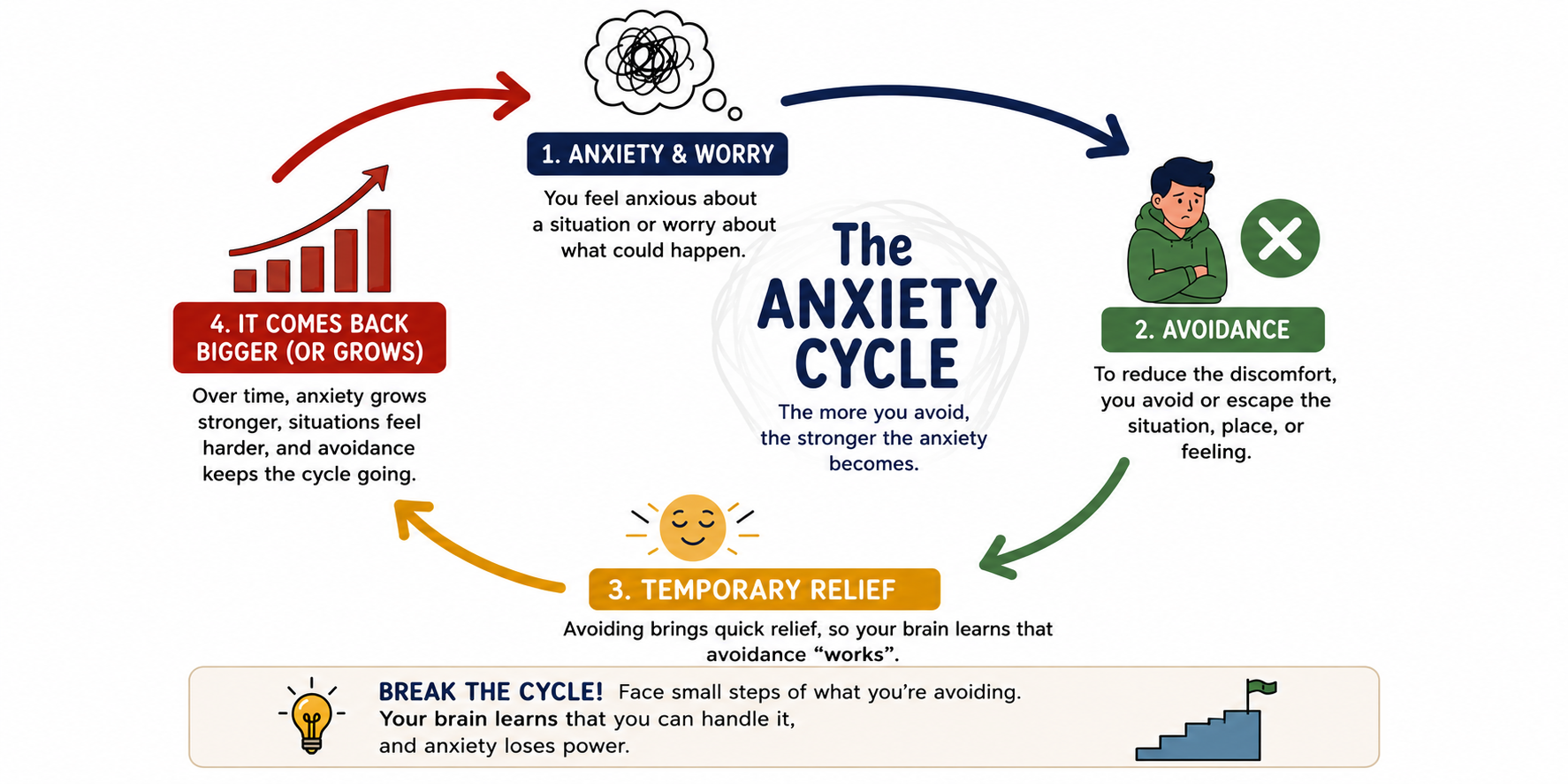
Everyone has a worry monster. The key is that you don’t feed it. Cognitive Behavioral Therapy explains anxiety as a cycle.
You feel anxiety or fear, so you avoid it as much as you can. You feel better for a while, but the anxiety is heightened because your brain believes the only way to stay safe is through avoidance. The worry monster feeds on avoidance of your anxiety. Teach your child that the more they avoid things that make us anxious, the more they are feeding their worry monster, and it becomes harder and harder to face our fear when we continually feed him. We have a saying at our practice “The only way out is through”. This is the best way to navigate those worries, for the student to practice exposing themselves to the things that make them afraid. In therapy,this is often called Exposure and Response Prevention. We practice gradually exposing a patient to the things they are afraid of to train their brain that this threat is not as dangerous as their brain is letting on. As parents, helping them follow through with things even though they are scared may seem difficult in the moment, but it is for your students benefit that they don’t fall prey to the cycle of anxiety. Don’t feed that worry monster!
3: Seek Professional Assistance
Sometimes one of the best things you can do for your child is to realize you may need some additional support as parents and that is absolutely normal. How do you know you are at that point? There is not a one size fits all answer; however, there are some things worth highlighting that may be helpful for you as you decide what is best for your student. If you are seeing some of these signs/symptoms, you may want to consider additional support.
· School refusal: Your child strongly resists going to school, begs to stay home day after day, or cries and panics every morning.
· Frequent physical complaints: Your child frequently has severe stomachaches, headaches, or fatigue that pop up mainly on school days or school nights.
· Sleep disruption: Your child cannot fall asleep or stay asleep night after night due to racing worries.
· Extreme behavior changes: Your child shows intense irritability, frequent outbursts, deep sadness, or total withdrawal from friends and family.
· No improvement over time: Normal first-week jitters get worse instead of better after two or three weeks in the classroom.
It is okay if you do not have every answer to every one of your child’s complex challenges. You do not have to take that burden on by yourself. At 515 Therapy, we have a team of licensed therapists to come alongside you, and offer support to help your child better manage those feelings of anxiety. Our mission at 515 is to provide compassionate, evidence-based psychological testing, medication management, and mental health therapy for individuals, couples, and families across Iowa. This is not something you have to face alone. Let us know how we can assist your family. We would love to help.
.png)





.svg)
