Anxiety & Stress Management
Could I Have OCD?
November 1, 2026
Obsessive-compulsive Disorder (OCD) is often a misunderstood mental health diagnosis. Stereotype would have us think it is simply a personality quirk to prefer order, cleanliness, and stringent organization. In reality, OCD can be a debilitating mental health disorder in which a person struggles through a cycle of fear, intrusive thoughts, and compulsive behaviors. The cycle is relieving at first, but often leads to feelings of exhaustion and fatigue. If you find yourself constantly struggling with your own thoughts, playing mental gymnastics, or spending time engaging in compulsive behaviors to decrease your distress, you may have OCD.
What is OCD?
When we say we are “obsessed,” we usually mean that we are so infatuated with something (or someone) that it feels nearly impossible to pull our attention away. We casually say we are “obsessed” with a song, food, or personal hobby when we really like them, but we can still go about our days without them. But what happens if we become obsessed with our own thoughts?
Obsessive-compulsive disorder is a commonly recognized mental health disorder described in the DSM-5. Roughly 1 in 40 adults are affected by the disorder in their lives. Everyone experiences intrusive thoughts and engages in compulsive behaviors at some point in their lives, but OCD is diagnosed when these behaviors begin to disrupt day-to-day life and create mental distress.
Origins
OCD usually begins as an intrusive, anxious thought that is taken seriously. The thought often consists of an imagination of something terrible one could do. We do not know exactly where these thoughts come from or why they occur, but we know that everyone has them. Moreover,these fears often present as realistic events that hypothetically “could happen,” no matter how improbable.
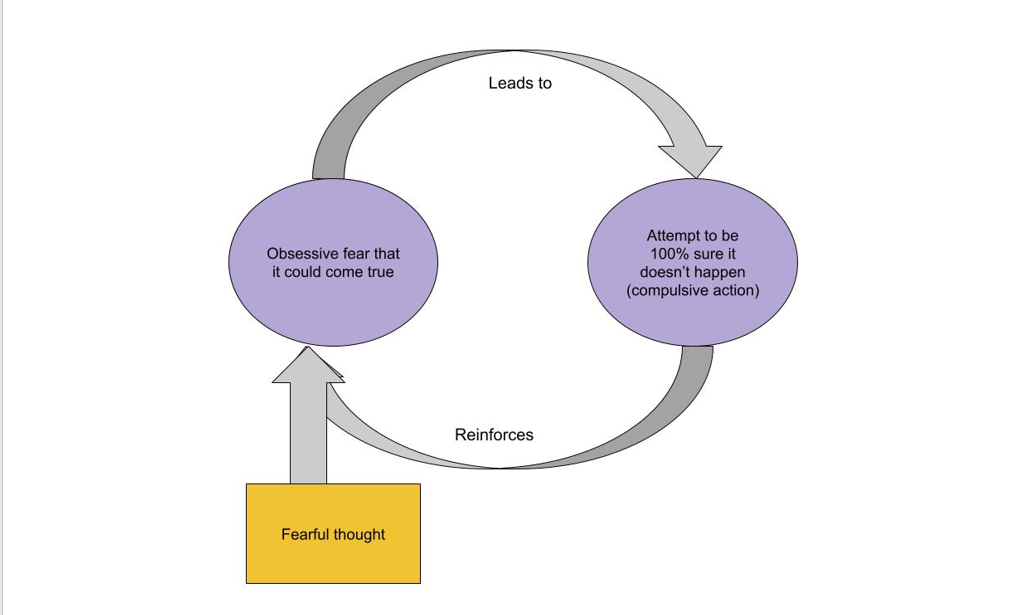
The cycle begins when one begins to believe the thought is a serious threat. And if the thought is believed as a true threat,one begins to believe they should “do something” about it in order to not allow it to come true. As one begins to obsess over an unwanted intrusive thought,they may begin to take action in order to relieve the thought. The person may find the action taken as relieving at first, but the thought always returns.Thus, a vicious cycle of obsessions and compulsive behavior is established.
What is an obsessive thought?
An obsessive thought is a mental thought, image, or idea that arises repetitively and frequently. These thoughts feel out of one’s control and are often seen as unwanted, disgusting, disturbing, or even dangerous. Those with OCD often recognize that the extreme focus on the thought is illogical but continue to find themselves struggling with it.
Obsessions feel time-consuming and exhausting. Feelings of guilt, doubt, mistrust in oneself, the need to constantly watch one’s brain, and anxiety for the future often come with obsessive thoughts. Moreover, the time spent obsessing over anxious thoughts begins to cloud the mind and take focus away from what one truly values in life.
What is a compulsion?
Compulsions are actions taken to attempt to relieve or neutralize obsessive thoughts. These actions are described as “compulsive” because they feel like the “right” thing to do to rectify the obsessive thought. Engaging in compulsions often provides temporary relief. However, by engaging in the compulsion, one reinforces the feeling that the obsession should be taken seriously in the future. Therefore, the obsessive thought inevitably arises again, and the same compulsion is engaged to quell the thought.
The person struggling with compulsive behaviors often has insight that engaging in the action is only temporarily relieving, but they find it difficult to stop. Those that struggle with OCD begin to loathe engaging in compulsions because it takes up time, energy, and focus away from one’s values in life. Despite this, disengaging from this cycle feels extremely uncomfortable, so it is very difficult to simply stop.
What does OCD look like?
We can understand how OCD works, but what does it actually look like? That question can be difficult to fully answer. OCD takes many different forms, and some are more noticeable than others.
Earlier, I mentioned that a fearful thought is often the genesis of an OCD cycle. This shocking thought almost always arises from one’s imagination and is always hypothetical. “What if I lose control and hurt my family members?” “What if I forget my loved ones?” “What if I come into contact with a deadly disease?” These are some examples of the intrusive thoughts and compulsive behaviors that one may begin to take and “run” with, leading to the OCD cycle.
Moreover, OCD can take the form of obsessions, OR compulsions, OR both. This means that some people struggle more with internal intrusive fears, while others may struggle primarily with compulsive behaviors. Some people struggle with both. So, what exactly do obsessions and compulsions look like?
Common Obsessions
Below are commonly identified obsessions that people tend to struggle with. Note that this list is not exhaustive:
- Contamination: Fear of coming into contact with perceived contaminated substances.
- Violence: Fear of acting on impulse to harm oneself or others, or a concern with violent images flashing through one’s mind.
- Responsibility: Fear of being responsible for something terrible happening, or fear of harming others due to not being careful (i.e.fear of backing over someone in a parking lot).
- Perfectionism: Excessive concerns over evenness, remembering, losing important things, doing things “perfectly,” or fear of making mistakes.
- Sexual: Unwanted mental images related to sex. Can include fears of acting on a sex-related impulse (including taboos), or acting sexually aggressive toward others.
- Religious/Moral: Fear of blaspheming, damnation, offending God, or excessive concern with morality and moral state.
- Identity: Excessive concern with one’s sexual orientation and/or gender identity.
- Others: Excessive concerns over relationships, death, numbers, words, and real/false memory.
Common Compulsions
Below are commonly identified compulsions that are acted on in order to relieve mental distress. Sometimes, compulsive behaviors can develop into rituals. Rituals are commonly repeated compulsions in response to obsessive thoughts. Sometimes, rituals can develop and remain even when obsessive thoughts are not present. Keep in mind that this is not an exhaustive list of compulsions and rituals:
- Washing and Cleaning: Washing, cleaning, or grooming excessively, or doing things to prevent contact with contaminants.
- Checking: Checking that one didn’t harm others or themselves, that nothing terrible happened, that one didn’t make a mistake, or one’s body parts.
- Repeating: Body movements (tapping, touching, blinking), routine actions (locking a door multiple times).
- Mental: Reviewing events to prevent harm, praying excessively, counting, or “undoing” certain thoughts or words
- Others: Arranging things to “perfection,” concern with symmetry, confessing for reassurance, and avoiding things/people/events that might trigger obsessive thoughts.
When should I get help for OCD?
Everyone has intrusive thoughts and acts compulsively. Everyone has their own personal rituals. Most everyone will do what they can to quell an anxious thought in their minds. So, where is the line between “normal behavior” and OCD?
The simple answer is when these symptoms begin to “disrupt daily functioning.” In other words, when the obsessive thoughts and/or compulsive behaviors begin to significantly affect the way we live our day-to-day lives. A strong gauge is if someone is taking at least one hour a day to deal with obsessive thoughts or compulsive actions, they have likely crossed the line where simple actions have become distressing symptoms.
Some may not realize how much time they spend on their obsessions or compulsions. For example, a mother may have obsessive fears over losing control of herself and violently harming others. She may spend hours in her own mind, constantly thinking of ways to keep herself and others safe from her own potential harm. She may throw out all the knives in the house. She may begin to avoid driving for fear of running someone down in her car. She may even begin to dread spending time with her children for fear of strangling them. For her, all of this time and dedication spent attempting to quell this fear may be completely reasonable because the fear itself feels serious and potential. For someone in this scenario, it may take a loved one to notice and point out that the person’s behaviors seem to be taking a lot of time and peace away from them, and that they should seek professional help with their problem.
Others may be painfully aware that spending time dealing with these thoughts cause significant distress, but they find it difficult or impossible to stop. They begin to notice they are less present, that their work is affected, that they are avoiding doing things they enjoy, or even that their relationships are becoming affected. Unfortunately, simple awareness of distress will not guarantee that it will go away. In fact, awareness of the symptoms can make it feel that the problem is even more daunting to conquer and can leave the person feeling stuck or hopeless. If you find yourself at this point, it is a sign to seek professional help for your symptoms.
How can therapy help OCD?
It can feel difficult to reach out for help. We may feel that we can deal with our problem on our own, or that we can tolerate our distress. The truth is, this distress is unnecessary, and help is out there. A proficient mental health provider will help listen to your struggles without judgment and will work with you at your own pace to help you handle these exhausting symptoms.
Treatment for OCD is common. Talk therapy and medication management are the strongest recommendations for treatment, and they are often used in tandem. In talk therapy, a therapist will help a client with specific approaches to help with their symptoms. Treatment for OCD does not always result in a complete cure for symptoms, but it can help reduce symptoms to the point where they no longer significantly affect daily life.
Exposure and Response Prevention
One of the strongest evidence-based approaches to treat OCD is called Exposure and Response Prevention (ERP). Essentially,ERP helps people to break the cycle of OCD by helping a client voluntarily confront the fears that afflict them, slowly but surely. An ERP trained therapist will first listen to the client and will help understand their symptoms. Then, the therapist and client will create a list of thoughts and situations that often lead to distress and will eventually determine the easiest ways to confront their fears. Finally, with the client’s complete and voluntary permission, the therapist will help the client face their fears, starting with the easiest challenge and slowly working their way up to greater fears. The ideal result is not that the client’s fears will completely disappear, but that the client will grow stronger; strong enough to face the fears on their own, at which point the fears no longer seem as frightening.
Medication Management
Medication often helps people deal with OCD symptoms. People often report that medication management can help “quiet” intrusive, fearful thoughts and curb desires to act on compulsive behaviors. Medication managers are trained professionals that will help talk you through symptoms and recommended medications. Medication managers include doctors, psychiatrists, physician assistants, and nurse practitioners.
How Can 515 Therapy Help?
If you or a loved one are struggling with intrusive thoughts, obsessive thinking, or compulsive behavior that is affecting your life, you do not have to deal with it alone. Our team of providers at 515 Therapy & Consulting are trained in evidence-based practices, including ERP and medication management, to help clients with OCD. Together, we can help you deal with these symptoms and find greater peace in life.
If you are ready to manage your OCD, please reach out to 515 Therapy to schedule an appointment and learn more about our services. We are happy to help!
FAQ
Q: What is the difference between OCD and Anxiety?
A: Anxiety and OCD share overlapping symptoms but are distinct mental health disorders. OCD often involves a specified fear (see list above) and results in a cycle of obsessive thoughts and/or compulsive behaviors related to the fear. Anxiety is often more generalized (can be about “anything and everything”) and results in avoidance or internal brooding. It has also been said that OCD presents as a “Fear of oneself,” (i.e. fear of one’s thoughts) and anxiety is a “Fear for oneself,” though this is not a holistic explanation. It is certainly the case that one can suffer from both OCD and anxiety simultaneously, and you should seek professional help if you believe this is the case.
Q: What is “invisible” OCD?
A: “Invisible OCD,” sometimes known as “Pure O,” is a type of OCD that cycles almost entirely in the mind. The cycle does not result in external, observable compulsions. Instead, one internally obsesses over a fear becoming true and engages in self-soothing mental checks to attempt to quell the fear. This sometimes results in internal compulsions such as counting, checking, mental “undoing,” or attempting to “think a way out” of the fear.
Q: Can Exposure Response Prevention make OCD worse?
A: If ERP is used correctly, OCD symptoms should not become worse. ERP sounds like an uncomfortable treatment, and it often can be. However, if one voluntarily exposes themselves to their fears (with a clinician’s help), the client will find a newfound strength in themselves to handle it. Additionally, there is a realization that the fear was not as dangerous as one thought. Voluntary willingness to face fears is perhaps the most important piece of treatment. If one is courageous enough openly to face the fear that most afflicts them, the fear loses power to hold the person in its grasp. Many of our popular stories tell this tale, whether it’s Harry Potter and the Boggarts or Sheriff Brody facing Jaws.